MUNICH, Sunday, February 15, 2026 (WNP): The European Union’s foreign policy chief Kaja Kallas on Sunday called on Europe to “reclaim agency in a rougher world,” outlining a three-pillar strategy focused on defence, neighbourhood stability and stronger global partnerships.
Delivering a keynote address titled “Europeans Assemble! Reclaiming Agency in a Rougher World” at the 62nd Munich Security Conference in Munich, Kallas said Europe must act with greater unity and confidence in the face of mounting geopolitical risks.
Opening with a nod to the Marvel-inspired theme of the panel, Kallas said Europeans understood what was at stake. “Not only our excellent living standards, health and happiness, but the lessons we have learnt from our own history,” she told an audience of global leaders, defence officials and policy experts.
Rejecting criticism that Europe was in decline, Kallas argued that the European Union remained an attractive political and economic project. “People still want to join our club,” she said, noting strong support for EU membership even beyond the continent. Enlargement, she stressed, was not only a political process but a geopolitical necessity.
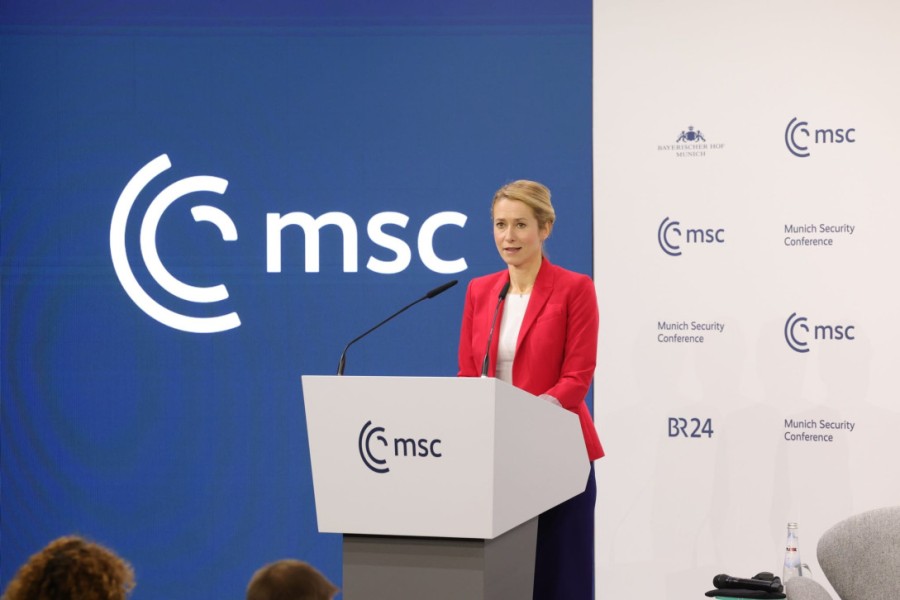
Kallas identified European defence as the first priority, warning that Russia’s ambitions extend beyond Ukraine.
“Russia’s endgame is not the Donbas,” she said, citing cyberattacks, disinformation campaigns, energy coercion and threats to critical infrastructure such as undersea cables and satellites. She also pointed to the persistent nuclear threat.
Working alongside European Commission President Ursula von der Leyen, Kallas said she was developing a comprehensive European security strategy covering defence, economic resilience and preparedness.
While describing Russia as “no superpower,” she cautioned that Moscow’s greatest leverage could come at the negotiating table rather than on the battlefield. She argued that any future settlement must include limits on military capabilities, accountability for war crimes, compensation for damage and the return of deported Ukrainian children.
“Russia’s maximalist demands cannot be met with a minimalist response,” she said, adding that Europe was increasing defence cooperation with allies in anticipation of a prolonged period of instability.
The second priority outlined by Kallas was stability in Europe’s eastern and southern neighbourhoods, with enlargement described as “the antidote to Russian imperialism.”
She noted that countries that joined the EU after the fall of the Soviet Union had experienced significantly faster economic growth than Russia. Enlargement, she argued, strengthens democracy and addresses the continent’s historical divisions.
“Today, enlargement is a geopolitical choice and we must say yes,” she said.
Kallas identified international partnerships as the third pillar of Europe’s strategy. The EU has built what she described as the world’s largest network of free trade agreements, covering nearly 80 countries.
Beyond trade, she said, the bloc is expanding security and defence cooperation agreements, including new partnerships with countries such as India and Australia.
In a world increasingly shaped by tariffs, supply chain risks and digital competition, countries are seeking diversified partnerships to protect stability and growth, she added.
“The vast majority of countries want stability, growth and prosperity for their people. The best way to get there is to go together,” Kallas said.
Concluding her address, Kallas reiterated her call for unity and resolve.
“Europe’s path is clear,” she said. “Defend Europe. Secure our neighbourhood. Build our partnerships across the globe.”
Her remarks come at a time of heightened global uncertainty, as European leaders debate defence spending, enlargement policy and the future direction of transatlantic and multilateral cooperation.