By Rehan Khan
Director Diplomatic & International Affairs
MAKKAH AL-MUKARRAMAH, Sunday, May 31, 2026 (WNP): In the shadow of Jabal Al-Noor, where the first verses of the Holy Quran were revealed to Prophet Muhammad (Peace Be Upon Him), a remarkable masterpiece created by a Pakistani woman is inspiring pilgrims and visitors from across the Muslim world.
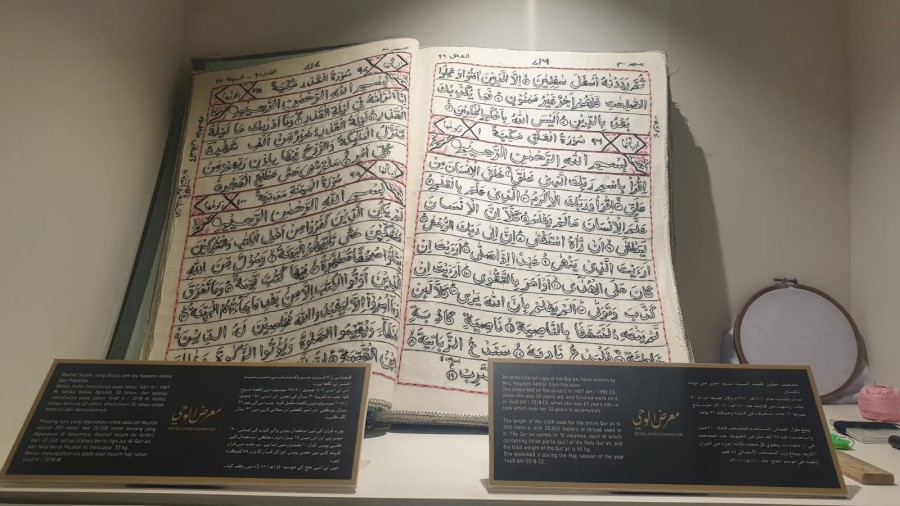
A hand-embroidered copy of the Holy Quran, painstakingly crafted over 32 years by Pakistan’s Naseem Akhtar, is on display at the Hira Cultural District, where one of its volumes has been opened to the verses of Surah Al-‘Alaq, beginning with the divine command: “Read in the name of your Lord who created.”
For countless visitors, the display is more than an artistic achievement. It is a powerful symbol of faith, perseverance, devotion to the Holy Quran, and the enduring spiritual bond that unites Muslims across generations and geographical boundaries.
Naseem Akhtar began work on the project in 1407 AH (1987 CE) at the age of 30 and completed it in 1440 AH (2018 CE) at the age of 62. Over three decades, she transformed nearly 300 meters of cloth into a complete embroidered copy of the Holy Quran using approximately 25,000 meters of thread.
The monumental work consists of ten volumes, each containing three juz’ of the Quran, and weighs a total of 55 kilograms.
Speaking previously to media, Naseem Akhtar described the project as a blessing bestowed upon her by Allah Almighty. “Everything is with Allah. He chooses whom He wills for His work, and perhaps He chose me as well,” she said.
She explained that her deep love for the Holy Quran inspired the idea. At the time, she was teaching embroidery and sewing to young women at Pakistan Air Force Industries. After experiencing personal disappointment in some aspects of life, she began thinking about leaving behind a lasting charitable legacy.
“I wanted to do something that would remain as Sadaqah Jariyah (continuous charity). The Quran was always before me. A person naturally thinks about what he or she loves most, and I loved the Quran. Then the idea came to me to embroider the Holy Quran.”
She recalled that when she started the work in August 1987, she had never heard of anyone embroidering an entire Quran before.
The journey was not without challenges. As a wife and mother, she balanced household responsibilities, raising children and maintaining family commitments while dedicating countless late-night hours to the project.
“For a woman, the greatest challenge is managing her home, caring for her children and fulfilling family obligations. Most of my work was done at night. In this way, 32 years passed and the Holy Quran was completed,” she said.
The project required enormous dedication and precision. Naseem used 180 boxes of high-quality embroidery thread and approximately 13 rolls of specially selected cloth sourced from Faisalabad. Despite rising costs over the years, she remained committed to completing the work.
Equally important to her was ensuring complete textual accuracy. She revealed that every page was checked repeatedly. The text was reviewed by a qualified Hafiz before embroidery began, examined again after embroidery, and reviewed once more after completion.
“When the Quran arrived in Makkah, twelve Huffaz also examined it and found no error whatsoever,” she said.
Her intention from the beginning, she explained, was not commercial gain or public recognition.
“I had made the intention from the very start that I would present this Quran as a gift in honor of the Prophet Muhammad (Peace Be Upon Him). Many people made offers, including offers worth millions, but I refused all of them. I did not create it for money or fame.”
Her wish was eventually fulfilled when the embroidered Quran was accepted and displayed in Saudi Arabia. “Allah opened the doors for me. The museum authorities honored the Quran and displayed it with great respect. They announced that it had been created by a great woman from Pakistan. That was a tremendous honor for me,” she said.
Today, one volume of the Quran is displayed in Jabal Omar, while another is exhibited near the Cave of Hira, where the opening verses of Surah Al-‘Alaq are presented to visitors.
Naseem considers its placement near the site of the first revelation among the greatest honors of her life. “For me, it is a tremendous privilege that my Quran is displayed beside the place where the first revelation descended upon the Prophet (Peace Be Upon Him),” she said.
She noted that museum officials informed her that the embroidered Quran is displayed alongside a copy associated with the era of Caliph Uthman ibn Affan (May Allah Be Pleased with Him).
“They told me that on one side is a Quran connected to the era of Uthman ibn Affan, and on the other side is this Quran of the modern era,” she recalled.
Naseem also shared stories illustrating the impact of the exhibit on visitors. According to museum officials, one visitor who had previously seen the embroidered Quran returned two years later and reported that the experience had inspired him to begin reading the Holy Quran regularly and that he had already progressed to the eighteenth juz’. Another visitor who had written a Quran in gold ink later brought his own work for display after being inspired by Naseem’s achievement.
“My goal was always to attract people toward the Quran—to encourage them to read it, understand it and love it,” she said. “I believe Allah accepted that effort.”
The exhibit has become a particular source of pride for Pakistani visitors performing Hajj and Umrah.
Muhammad Salman, a Pakistani visitor at the Hira Cultural District, said he was overwhelmed with emotion upon seeing the masterpiece. “As a Pakistani, I feel immense pride seeing this extraordinary work displayed in Makkah near the place where the first revelation descended. This is not merely embroidery; it is a manifestation of love for the Holy Quran and devotion to Islam,” he said.
“What makes it even more remarkable is that such a unique artistic presentation of the entire Holy Quran has rarely, if ever, been seen in centuries. It is a contribution that brings honor not only to Pakistan but to the entire Muslim Ummah.”
He added that the display demonstrates how sincere faith, patience and dedication can leave a lasting legacy for future generations.
For visitors to the Hira Cultural District, the embroidered Quran serves as a reminder that the Holy Book remains at the heart of Muslim life, guiding believers toward faith, knowledge, compassion and righteousness.
As pilgrims from around the world gather around the exhibit, many pause in silent reflection, inspired by the story of a woman who devoted 32 years of her life to preserving the words of Allah through thread and cloth—creating a masterpiece that now stands near the very place where the light of revelation first illuminated humanity.