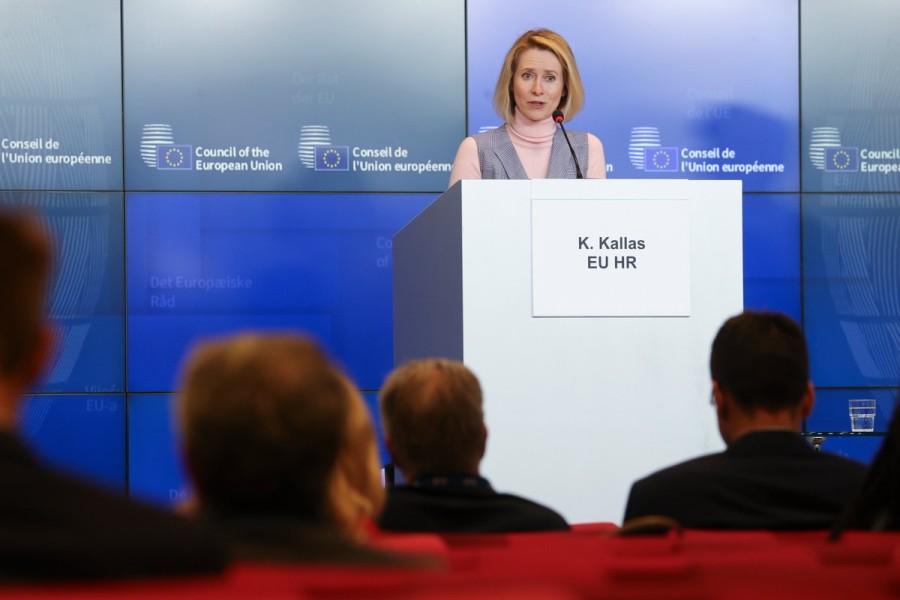
LUXEMBOURG, Tuesday, April 21, 2026 (WNP): The European Union has warned of growing risks in the Iran-related conflict and signaled plans to expand sanctions, while reaffirming support for diplomacy and regional engagement, EU foreign policy chief Kaja Kallas said following a Foreign Affairs Council meeting.
Addressing a press conference, Kallas said EU foreign ministers held “long but focused” discussions covering Ukraine, the Middle East, and other global hotspots, emphasizing the need for coordinated responses to evolving geopolitical challenges.
On Iran, she said ministers agreed that freedom of navigation, particularly through the Strait of Hormuz, is “non-negotiable,” warning that uncertainty over maritime access was “reckless.” She announced a political agreement to widen the EU’s sanctions regime to target individuals and entities responsible for disrupting shipping routes.
Kallas added that while the EU already maintains sweeping sanctions on Iran, further measures were under preparation and could be finalized by the next Foreign Affairs Council meeting in May.
She reiterated that any long-term settlement with Iran must go beyond nuclear concerns to address missile programmes, cyber and hybrid threats, and Tehran’s regional activities.
On the broader Middle East, Kallas said ceasefires involving Iran and Lebanon were largely holding but remained fragile, urging all parties to sustain diplomatic efforts. She also highlighted EU humanitarian assistance to Lebanon and ongoing support for the Lebanese Armed Forces.
Turning to Palestine, she emphasized the EU’s role as the largest supporter of the Palestinian people and called for renewed momentum toward a Palestinian-led political process based on a two-state solution.
On Ukraine, Kallas accused Russia of intensifying attacks despite an Orthodox Easter ceasefire and reaffirmed the EU’s commitment to continued military, financial, and training support for Kyiv.
She expressed optimism that a €90 billion loan package could be approved within 24 hours and called for progress on the bloc’s 20th sanctions package against Russia.
The meeting also addressed the South Caucasus, with the EU agreeing to establish a new civilian mission in Armenia and expressing support for normalization efforts between Armenia and Azerbaijan, while voicing concern over democratic backsliding in Georgia.
Ministers further discussed Syria, Sudan, and global energy security, with Kallas stressing the importance of diversifying energy supplies to reduce dependence on fossil fuels and mitigate geopolitical vulnerabilities.
She said the EU would continue engaging with international partners across multiple regions, while advancing sanctions, diplomacy, and security cooperation to address complex global crises.