ISLAMABAD, Tuesday, November 18, 2025 (WNP): Marking GIS Day 2025, WWF-Pakistan launched its pioneering Plantation Dashboard—a first-of-its-kind geospatial platform aimed at transforming how large-scale ecological restoration across Pakistan is tracked, verified, and communicated.
The digital tool brings an unprecedented level of transparency and scientific rigor to one of Pakistan’s largest conservation-led plantation programmes.
Developed by specialists at the Richard Garstang Geographic Information Systems (GIS) Lab, the platform visualizes Pakistan’s restoration footprint using interactive maps, field-verified datasets, and spatial analytics. With real-time monitoring and open access, the dashboard positions Pakistan among countries setting global standards for digital accountability in environmental restoration.
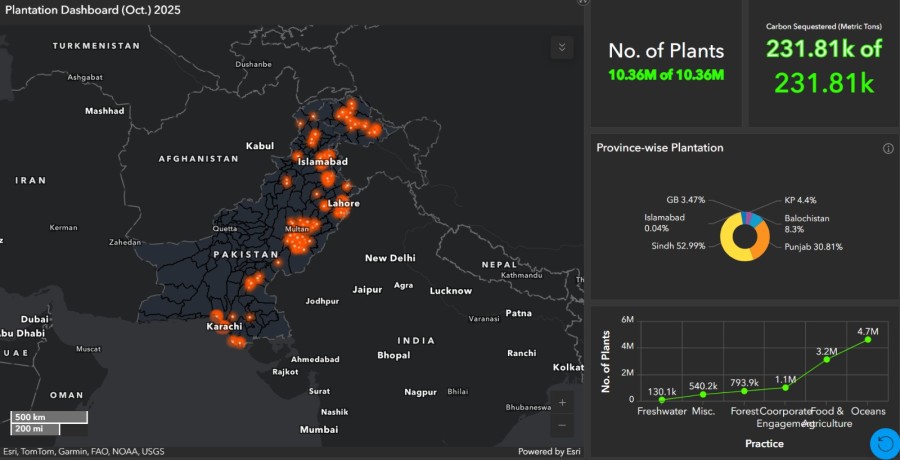
As of October 2025, WWF-Pakistan and its partners in government, the private sector, and civil society have planted 10.36 million trees. These efforts contribute to an estimated 231,800 metric tons of carbon sequestration annually, reinforcing the nation’s natural carbon sinks and strengthening resilience across vital landscapes—from coastal mangroves and riverine forests to arid ecosystems and community-managed restoration sites.
“Plantation and natural carbon sequestration remain among Pakistan’s most powerful tools against climate change,” said Ibrahim Khan, Director Forest Conservation at WWF-Pakistan. “Restoring degraded landscapes is not only crucial for biodiversity but also for the communities that depend on these ecosystems. This dashboard provides a clear, scientifically credible way to demonstrate the scale and impact of our work.”
The dashboard’s interactive map offers users a dynamic view of verified plantation sites nationwide. Early insights show that Sindh and Punjab account for the largest share of plantations—52% and 33% respectively—reflecting WWF-Pakistan’s targeted, ecosystem-specific restoration strategy. The platform also highlights the contributions of landmark initiatives, including coastal mangrove expansion and community-driven afforestation, while its live carbon gauge tracks sequestration benefits aligned with Pakistan’s Paris Agreement commitments, SDG 13, national resilience targets, and the Ten Billion Tree Afforestation Programme.
“This dashboard is more than a visualization tool—it is a decision-support system,” emphasized Usman Akram, Senior Manager GIS at WWF-Pakistan. “By integrating spatial intelligence with ground data and environmental indicators, we are making conservation measurable, transparent, and accessible to policymakers, academics, and the public.”
The launch of the Plantation and Carbon Sequestration Dashboard signals WWF-Pakistan’s continued commitment to harnessing technology, science, and community collaboration to restore degraded ecosystems and build a climate-resilient Pakistan.
Established in 1970, WWF-Pakistan is a non-profit organization dedicated to conserving the country’s biodiversity, natural resources, and environment. Operating through 26 offices and nearly 250 staff members, WWF-Pakistan delivers conservation and climate resilience projects across the country, with its head office in Lahore and regional offices in major cities.