ISLAMABAD, Tuesday, June 9, 2026 (WNP): Federal Minister for Planning, Development and Special Initiatives Professor Ahsan Iqbal on Tuesday said the 75-year friendship between Pakistan and China remains one of the most enduring and successful diplomatic relationships in modern history, adding that bilateral cooperation is now poised to reach “the skies” as Pakistan prepares to send its first astronaut into space through a Chinese mission.
Addressing a ceremony organized by the Institute of Strategic Studies Islamabad (ISSI) with the support of the Chinese Embassy during celebrations marking the 75th anniversary of Pakistan-China diplomatic relations, Ahsan Iqbal described the relationship as a unique bond that has continued to grow stronger without interruption despite changing regional and global circumstances.
“Many friendships in the world have witnessed ups and downs, but the Pakistan-China relationship has continued on an uninterrupted path of progress. It is a friendship that has never experienced a moment of tension and has continued to flourish with new blossoms of cooperation,” he said.
The minister noted that Pakistan and China have traditionally described their friendship as being “higher than the Himalayas,” but said the relationship would soon extend beyond the mountains and into space through a joint space cooperation initiative.
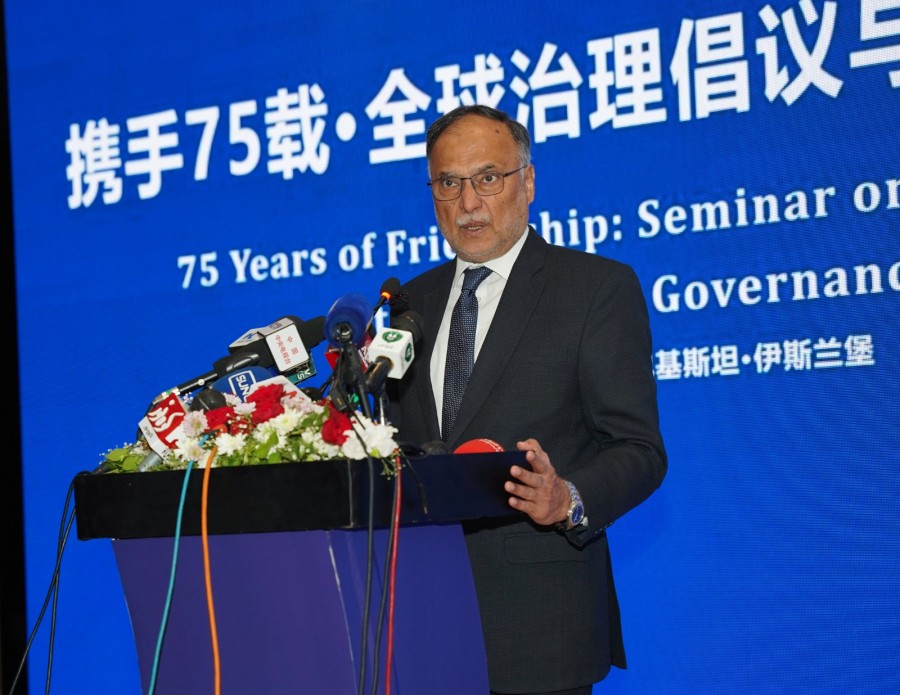
“With China’s cooperation, Pakistan’s first astronaut will travel into space and receive training at Chinese facilities. This friendship will not only rise above the Himalayas but will also touch the heavens,” he remarked.
Ahsan Iqbal recalled that philosopher-poet Allama Muhammad Iqbal had foreseen China’s emergence as a major global power nearly a century ago and had envisioned a future in which connectivity and cooperation would reshape Asia.
He said the China-Pakistan Economic Corridor (CPEC) represents that vision by transforming geographical barriers into bridges of prosperity and connectivity.
“The Himalayas, once viewed as barriers, have become bridges connecting our peoples through cooperation and shared prosperity,” he added.
The minister reflected on the origins of CPEC, recalling that the Memorandum of Understanding for the project was signed during former Prime Minister Muhammad Nawaz Sharif’s visit to Beijing in 2013.
“I had the honour of signing the memorandum on behalf of Pakistan. At that time, CPEC was merely a dream embodied in a piece of paper. Today, it stands as one of the world’s most successful development partnerships,” he said.
He noted that Chinese President Xi Jinping’s historic visit to Pakistan led to the signing of agreements worth $46 billion, formally launching the first phase of CPEC.
According to Ahsan Iqbal, nearly $25 billion of Chinese investment was transformed into operational projects within a few years, a development he described as a remarkable achievement made possible through the commitment of both countries.
By 2017-18, he said, CPEC had become a globally recognized brand, attracting interest from major developed countries and international investors.
The planning minister said Pakistan and China are now focused on the successful implementation of CPEC Phase-II, which is built around five major development corridors.
The Corridor of Growth will help strengthen Pakistan’s productive capacity, export competitiveness and sustainable economic growth.
The Corridor of Livelihoods seeks to improve the lives of ordinary citizens, particularly in underdeveloped regions, by generating employment opportunities and enhancing living standards.
The Corridor of Innovation is designed to prepare Pakistan for the Fourth Industrial Revolution through cooperation in advanced technologies, including Artificial Intelligence, research and innovation.
The Green Corridor focuses on renewable energy, environmental sustainability and climate resilience to help Pakistan address the growing challenges of climate change.
The Open Corridor seeks to expand the benefits of CPEC beyond Pakistan and China by encouraging broader regional connectivity and cooperation with other countries.
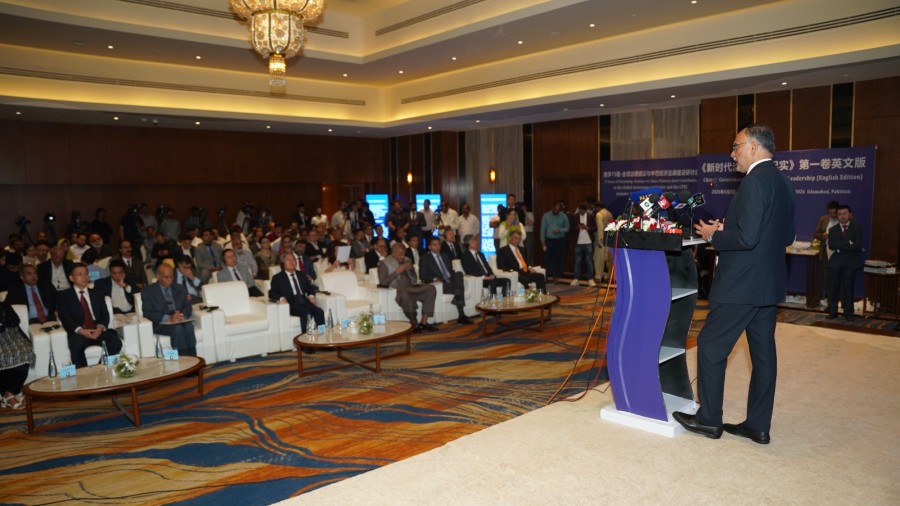
“We want other nations to connect with CPEC, benefit from it and participate in building a shared vision of regional prosperity,” he said.
Discussing Chinese President Xi Jinping’s Global Governance Initiative, Ahsan Iqbal said the framework addresses many of the challenges facing the international community and provides a constructive path toward a more balanced and peaceful world order.
He outlined five key principles underpinning the initiative: respect for sovereign equality, adherence to international law, commitment to multilateralism, people-centered development and a focus on practical results.
According to the minister, these principles are essential at a time when the world faces increasing geopolitical tensions, economic uncertainty and institutional challenges.
He stressed that respect for sovereignty and international law remains fundamental to maintaining global peace and preventing the emergence of a world governed by power rather than rules.
The minister also highlighted the importance of multilateralism, arguing that no nation can address today’s complex global challenges alone and that the voices of developing countries must be given greater representation in international decision-making processes.
Ahsan Iqbal praised China’s development model, particularly its success in lifting more than 800 million people out of poverty, describing it as a powerful example of people-centered development.
He emphasized that the true measure of development should be its ability to improve the lives of ordinary citizens rather than merely generating economic statistics.
“The ultimate purpose of economic growth and international cooperation must be to improve human lives, create opportunities and raise living standards,” he said.
The minister warned that information warfare has become one of the defining challenges of the modern era.
“In today’s world, wars are increasingly fought in the information domain. Missiles are launched later; misinformation and disinformation are often deployed first,” he said.
Referring to discussions at the World Economic Forum, he noted that fake news and misinformation are now considered among the most significant threats facing humanity because they create confusion, erode trust and fuel instability.
Ahsan Iqbal recalled that CPEC itself had faced coordinated disinformation campaigns during its early years but succeeded because of effective communication and public engagement.
He called for greater cooperation between Pakistan and China in the fields of information, media and communications to counter misinformation, promote accurate narratives and strengthen people-to-people understanding.
The minister also advocated expanding cultural exchanges and media collaboration between the two countries.
He expressed hope that Pakistani television dramas and films would eventually be broadcast on Chinese television just as Chinese productions are increasingly viewed in Pakistan.
“Through stronger cultural exchanges, people can better understand one another’s traditions, values and aspirations, which ultimately strengthens friendship and cooperation,” he said.
Concluding his address, Ahsan Iqbal congratulated the organizers of the conference and paid tribute to China’s Xinhua News Agency for its role in presenting China’s development story to global audiences.
He reaffirmed Pakistan’s commitment to deepening strategic cooperation with China and expressed confidence that CPEC Phase-II and the Global Governance Initiative would contribute significantly to regional prosperity, global stability and a more inclusive international order.
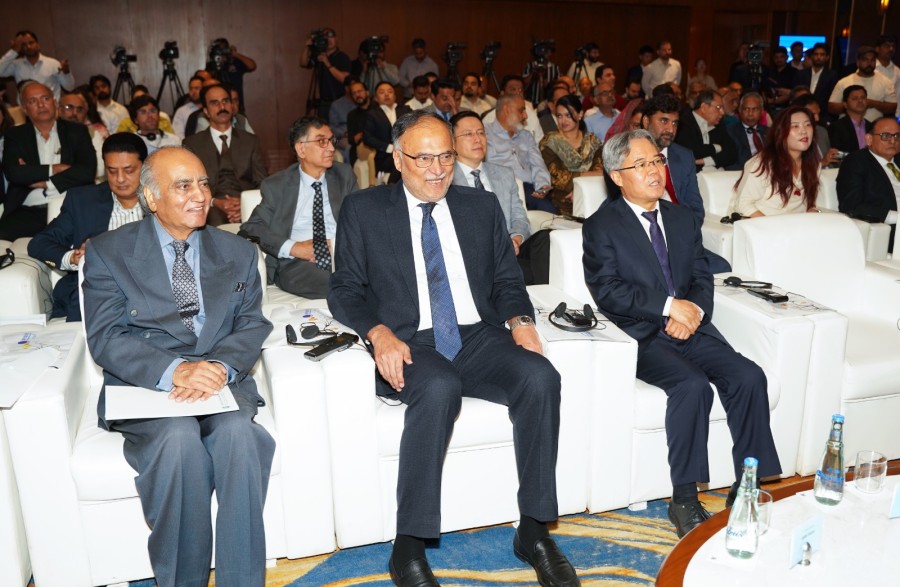
“Pakistan-China friendship is no longer just higher than the Himalayas; it is now preparing to reach the stars.”