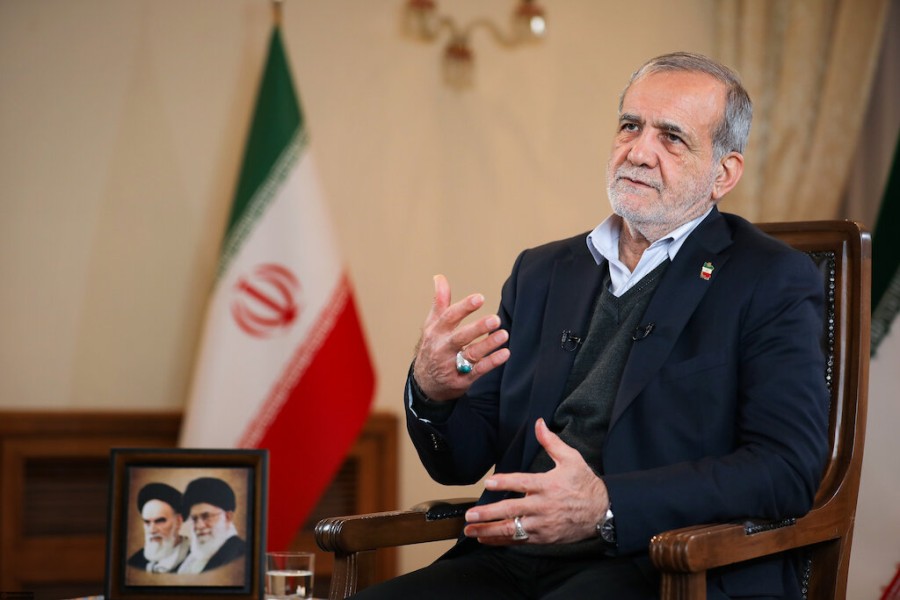
TEHRAN, Saturday, December 27, 2025 (WNP): Iranian President Dr. Masoud Pezeshkian has outlined an ambitious reform agenda aimed at correcting deep structural imbalances in the country’s energy, economic and governance systems, asserting that Iran is steadily advancing despite sanctions, regional tensions and sustained external pressure.
In a wide-ranging interview with Khamenei.ir, President Pezeshkian credited the Supreme Leader of the Islamic Revolution for his continued public and private support of the administration, describing it as critical to maintaining stability and policy continuity. He said the government’s central challenge since taking office has been addressing long-standing “imbalances” across key sectors, including energy, water, finance, management and social development.
Pezeshkian revealed that the government inherited a severe energy shortfall, initially estimated at 20,000 megawatts and later rising to nearly 30,000 megawatts due to drought, reduced hydropower output and rising consumption. He said the administration adopted a dual strategy of curbing excessive consumption while rapidly expanding supply through renewable sources.
According to the president, more than 3,000 megawatts of solar energy have already been added to the national grid this year—three times the total installed in previous years—with an additional 800 megawatts scheduled to come online imminently. Solar capacity is currently expanding at a pace of around 300 megawatts per week, supported by contracts totaling nearly 80,000 megawatts. Pezeshkian said the transition would significantly reduce fossil fuel dependence and carbon emissions.
He also cited progress in activating combined-cycle power plants, noting that 3,000 megawatts have been brought online, with work continuing on the remaining 4,000 megawatts. Measures to regulate cryptocurrency mining and manage consumption growth, he added, have helped save thousands of megawatts.
Highlighting infrastructure as a strategic priority, the president said major transit corridors—including Astara–Rasht, Shalamcheh–Basra and Zahedan–Chabahar—are expected to be completed within the year, subject to smooth coordination with regional partners. Billions of tomans have been allocated to these projects, which are seen as vital to boosting trade and regional connectivity.
Pezeshkian also pointed to improved relations with neighboring countries and key partners such as China, Russia and Central Asian states, describing regional corridors as central to Iran’s long-term economic strategy.
On social development, the president emphasized mosque- and neighborhood-centered initiatives designed to strengthen public participation. He said more than 10,000 mosques, along with schools and health centers, have been mobilized to support community-based programs.
In education, Pezeshkian reported that makeshift schools have been replaced and more than 10 million square meters of educational space constructed with public and philanthropic support. Teaching methods and classroom layouts are also being modernized, with a focus on educational justice in underprivileged areas.
In healthcare, he said pilot implementation of the Family Physician Plan has begun in dozens of cities, aiming to ensure universal access, clear service responsibility and fair compensation without direct financial burden on patients.
Addressing economic hardship, Pezeshkian acknowledged falling oil revenues, war-related disruptions and inflationary pressures. He said the government plans to allocate around $2.5 billion by the New Year to support targeted subsidies and electronic food coupons.
He defended proposed reforms to fuel subsidies, arguing that current policies disproportionately benefit car owners. “These subsidies belong to all citizens,” he said, stressing that savings from consumption reforms would be redirected to public welfare rather than government finances. The administration, he added, has introduced a tightly controlled budget with minimal growth and significant cost reductions.
Rejecting Western media narratives portraying Iran as weak or incapable, Pezeshkian said recent crises—including a 12-day conflict—demonstrated strong internal cohesion and effective decentralization. He credited the delegation of authority to provincial leaders for maintaining uninterrupted services and logistics during periods of heightened tension.
The president underscored unity as Iran’s greatest strength, warning that internal divisions pose a greater risk than external threats. He reiterated his commitment to continuity in national development plans, stating that his administration is completing projects initiated by previous governments rather than pursuing abrupt policy shifts.
“We are under pressure from every direction,” Pezeshkian said, “but if we stand together, manage our resources wisely and involve the people in decision-making, no force can incapacitate this nation.”
Concluding the interview, the president emphasized that his administration’s guiding principle is service without discrimination, grounded in justice, restraint and national solidarity, expressing confidence that Iran can overcome current challenges through collective effort and disciplined governance.