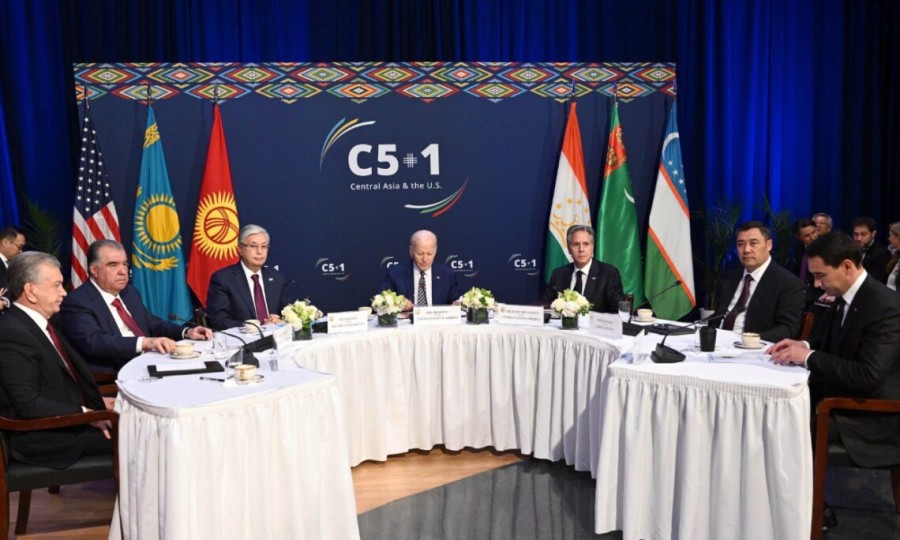
TASHKENT, Monday, November 10, 2025 (WNP): Uzbekistan is reinforcing its regional and global engagement through the “C5+1” platform — a key strategic dialogue mechanism uniting the United States and Central Asian countries — as the region moves toward deeper economic integration, sustainable development, and mutual trust.
Once a diplomatic framework, the “C5+1” has now evolved into an effective platform for policy coordination and project implementation. The recent ministerial meeting in Samarkand, attended by Uzbekistan’s Minister of Investment, Industry, and Trade Laziz Kudratov, underscored the growing confidence among member nations and their focus on tangible results. Discussions centered on food security, climate resilience, green and digital economies, transport connectivity, and industrial cooperation.
The meeting concluded with the signing of memorandums on decarbonization and digitalization of customs procedures, marking a significant step toward harmonized trade regulations and streamlined cross-border exports. These initiatives are expected to attract greater foreign investment and strengthen Central Asia’s role as a dynamic economic hub.
Over the past five years, Central Asia’s foreign trade turnover has nearly doubled to $220 billion, with mutual investments increasing 5.6 times and the region’s combined GDP rising by 40% to exceed $406 billion. This transformation highlights a shift from fragmented national projects to coordinated regional strategies.
Uzbekistan’s economic partnerships within the region illustrate this new phase of integration. Trade with Kazakhstan reached $3.03 billion between January and August 2025 — up 15 percent — with joint projects worth over $7 billion in engineering, agriculture, construction, and energy. Meanwhile, Tajikistan and Uzbekistan have deepened cooperation in rail and energy sectors, handling 10 million tons of cargo in 2024 and establishing a $100 million joint investment company.
Collaboration with Turkmenistan has expanded in logistics and manufacturing, with bilateral trade surpassing $1.14 billion and the Shavat–Dashoguz border zone emerging as a cross-border industrial hub. Similarly, Uzbekistan’s partnership with Kyrgyzstan continues to grow, supported by a 2030 interstate roadmap and new transport routes that enhance competitiveness; trade between the two nations approached $600 million in 2025, with Uzbek exports up nearly 80 percent.
The “C5+1” framework also aligns the region’s ambitions with global sustainability goals. It promotes cooperation in renewable energy, resilient supply chains, infrastructure modernization, digital trade, and human capital development. For Central Asia, the benefits include enhanced investment opportunities, greater energy security, and improved access to global markets.
For Uzbekistan, the platform provides a practical path to achieving long-term national objectives: expanding export potential, advancing technology localization, strengthening industrial partnerships, and ensuring macroeconomic stability.
As the region transitions from being merely a geographical crossroads to a center of economic synergy, the “C5+1” partnership stands out as a model of pragmatic diplomacy — one that unites regional aspirations with global cooperation. For Uzbekistan, it represents not just a foreign policy choice, but a strategic tool to drive industrialization, boost exports, and elevate living standards across the nation.