
By Akramjon Ne’matov,
First Deputy Director
Institute for Strategic and Interregional Studies
under the President of the Republic of Uzbekistan
TASHKENT, Monday, February 9, 2026 (WNP): The recent state visit of President of the Republic of Uzbekistan Shavkat Mirziyoyev to Pakistan has marked a defining moment in bilateral relations, elevating cooperation between the two countries to the level of a comprehensive strategic partnership. By its scale, depth of engagement, and tangible outcomes, the visit can rightly be described as historic, signaling a transition from traditional intergovernmental interaction to a multidimensional, institutionalized partnership.
The visit featured an exceptionally intensive program, reflecting the shared ambition of Tashkent and Islamabad to build a long-term, sustainable model of cooperation.
A key political milestone was the first meeting of the High-Level Strategic Partnership Council, established in February 2025 during Prime Minister Shehbaz Sharif’s visit to Uzbekistan. The launch of this mechanism represents a shift toward systematic coordination of political, economic, and humanitarian agendas at the highest level.
Separate meetings with President of Pakistan Asif Ali Zardari and Prime Minister Shehbaz Sharif underscored the high degree of political trust and convergence of views on bilateral development, regional security, and sustainable growth. The visit also included discussions with Pakistan’s Chief of Defence Forces, Field Marshal Asim Munir, highlighting the mutual interest in expanding security cooperation and military-technical interaction amid an increasingly complex regional and global security environment.
Against the backdrop of global uncertainty, supply-chain fragmentation, rising protectionism, and mounting climate and resource challenges, the strengthening of Uzbek–Pakistani strategic partnership emerges as a stabilizing factor for the wider region. The partnership provides a reliable platform for coordinated responses to shared challenges while contributing to resilience and stability across Central and South Asia.
A defining feature of the current phase of relations is their comprehensive scope. Cooperation now spans politics, trade, investment, transport and infrastructure, industrial development, digital technologies, education, science, and culture.
This evolving partnership is fostering a new model of interregional connectivity, generating employment, increasing incomes, and strengthening economic resilience in both countries, while contributing to a broader architecture of regional integration.
Economic cooperation stood at the heart of the visit’s practical outcomes. Bilateral trade has grown dramatically—from approximately USD 30 million in 2017 to nearly USD 500 million in 2025—representing more than a fifteenfold increase. Both sides have set an ambitious target of expanding trade to USD 2 billion in the near term, supported by the establishment of a joint working group and the development of a five-year roadmap.
Beyond quantitative growth, the structure of trade is undergoing qualitative transformation, with increasing emphasis on value-added products such as industrial goods, textiles, pharmaceuticals, agricultural produce, and construction materials. Agreements to expand trade preferences to over 40 product categories on each side and to increase phytosanitary permits are expected to significantly reduce barriers and accelerate trade flows.
Investment cooperation has also gained momentum. Pakistani investments in Uzbekistan reached approximately USD 33 million in 2024 and more than doubled to nearly USD 70 million in 2025. Currently, around 230 enterprises with Pakistani capital operate in Uzbekistan across sectors including agriculture, textiles, food processing, mining, construction materials, pharmaceuticals, and banking—reflecting growing confidence in Uzbekistan’s investment climate.
A high-level business forum held during the visit, attended by President Mirziyoyev and Prime Minister Sharif, provided a platform for advancing concrete joint projects, strengthening private-sector ties, and expanding cooperation in manufacturing and high-tech industries.
Separate meetings with leading Pakistani companies—Engro Group, Gohar Textile, Go Group, and HRL Group—focused on technology transfer, workforce development, export expansion, and long-term joint investments.
Collectively, the visit resulted in a portfolio of joint projects valued at approximately USD 3.5 billion, underlining serious and sustained business interest. The decision to establish the Uzbekistan–Pakistan Business Council further institutionalizes economic cooperation by providing a permanent platform for enterprise-level engagement and project coordination.
More than 30 bilateral agreements signed during the visit attest to the breadth of cooperation, covering foreign policy, security, trade, industry, agriculture, digital technologies, education, culture, ecology, emergency response, and law enforcement.
The partnership has also been extended to regional and academic levels through the establishment of a Forum of Regions, city-level cooperation between Termez and Peshawar, and Samarkand and Islamabad, as well as agreements between leading research and academic institutions.
Transport and logistics cooperation featured prominently, particularly the Trans-Afghan railway project, viewed as a strategic geo-economic initiative linking Central Asia with South Asian ports. The project is expected to reduce cargo transit times from 35 days to 3–5 days, cut transport costs by up to 40 percent, and initially handle 3 million tons of cargo annually, with potential expansion to 15–20 million tons. Complementary agreements on multimodal corridors and expanded air connectivity further enhance regional interconnectivity.
Industrial and technological cooperation is being deepened across textiles, food processing, pharmaceuticals, construction materials, electrical engineering, and logistics, with particular emphasis on digital transformation. Joint IT clusters, startup support, artificial intelligence, and smart technologies are seen as key drivers of modernization and competitiveness.
The cultural and humanitarian dimension continues to reinforce economic ties. Educational exchanges are expanding, with Pakistani students in Uzbekistan increasing from 1,300 in 2023 to over 1,600 in 2025. Tourism is also on an upward trajectory, with more than 10,000 Pakistani tourists visiting Uzbekistan in 2025—nearly 2.5 times the number in 2023—supported by direct flights and joint cultural initiatives.
Plans to hold Weeks of Uzbek Culture and Days of Uzbek Cinema in Pakistan, along with enhanced cooperation in pilgrimage tourism and the establishment of a joint cultural center in Lahore dedicated to Baburid heritage, aim to further deepen people-to-people ties.
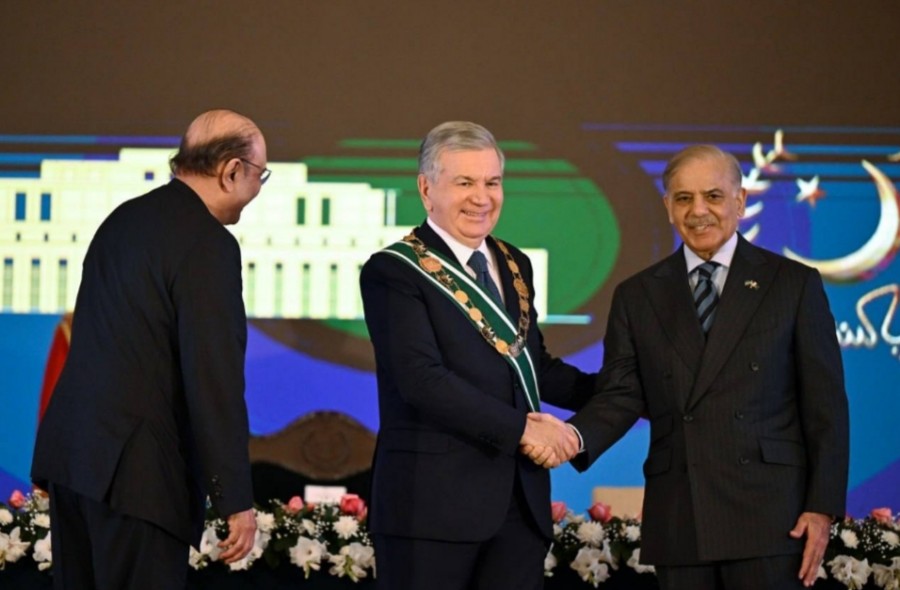
The visit carried strong symbolic significance with Pakistan conferring its highest state honor, the Nishan-e-Pakistan, on President Mirziyoyev, along with awarding him the title of Honorary Doctor and Professor at the National University of Sciences and Technology. Additional initiatives, including the naming of Tashkent Street and Babur Park in Islamabad, underscore shared historical memory and cultural affinity.
The institutionalization of expert dialogue through the establishment of a joint Uzbek–Pakistani Expert Council further ensures sustained analytical support and effective implementation of agreements.
Overall, President Shavkat Mirziyoyev’s state visit to Pakistan stands as a landmark event that not only consolidated the strategic partnership achieved thus far but also laid a robust foundation for its future expansion. The outcomes of the visit strengthen Uzbek–Pakistani cooperation as a key pillar of stability, connectivity, and development in Central and South Asia at a time of global turbulence.


