TASHKENT, Friday, March 6, 2026 (WNP): Uzbekistan has intensified its nationwide campaign against corruption in recent years, implementing a broad set of legal, institutional, and digital reforms aimed at transforming governance systems and strengthening transparency across the public sector.
What began with legislative changes has gradually developed into a multi-layered anti-corruption model combining legal modernization, digital governance, public accountability, and international cooperation.
A major milestone in the reform process was the adoption of the Law “On Combating Corruption” in 2017, which laid the foundation for Uzbekistan’s current anti-corruption policy. Since then, the government has introduced more than 30 related legal and regulatory measures to reinforce the framework.
These reforms include clearer rules on conflicts of interest and gift policies for public officials, stricter criminal penalties for bribery, and the integration of anti-corruption principles into Uzbekistan’s updated Constitution. Officials say this constitutional recognition reflects the government’s commitment to making integrity a core national priority.
A central element of Uzbekistan’s strategy is the use of digital technology to reduce opportunities for corruption by limiting discretionary decision-making and direct interaction between citizens and officials.
Under the principle that “documents move, not citizens,” Public Service Centers have been established across the country. Through the Unified Interactive Public Services Portal, more than 775 government services are now available online.
Digital transparency initiatives have also expanded public oversight. The Open Data Portal (data.gov.uz) and the Open Budget Portal (openbudget.uz) publish extensive government data, including 42 categories of socially significant information.
These measures have contributed to Uzbekistan’s improvement in international rankings, with the country rising 138 positions in the global Open Data index, reaching 11th place worldwide and first in Central Asia.
In 2020, Uzbekistan established the Anti‑Corruption Agency of Uzbekistan, which reports directly to the president while remaining accountable to parliament.
National and regional anti-corruption councils were created alongside parliamentary committees responsible for oversight. The government now submits an Annual National Anti-Corruption Report to parliament, providing an institutional mechanism for monitoring progress and identifying policy gaps.
In addition, compliance units have been introduced across most government agencies and state-owned institutions, including banks. These units focus on risk assessment, prevention mechanisms, and internal monitoring, reflecting a shift toward preventive governance rather than solely punitive enforcement.
Public procurement — traditionally considered one of the sectors most vulnerable to corruption — has also undergone reform.
A new procurement law has been introduced, supported by digital platforms such as d.xarid.uz, e-xarid.uz, and cooperation.uz, which allow transparent and competitive bidding processes.
Targeted initiatives, including “Corruption-Free Sector,” “Corruption-Free District,” and “Open and Accountable Ministry” pilot projects, focus on sectors with higher corruption risks such as construction, healthcare, higher education, and procurement.
Authorities have also introduced mechanisms to encourage public participation in anti-corruption efforts. Whistleblowers are offered legal protections and incentives for reporting corruption-related offenses.
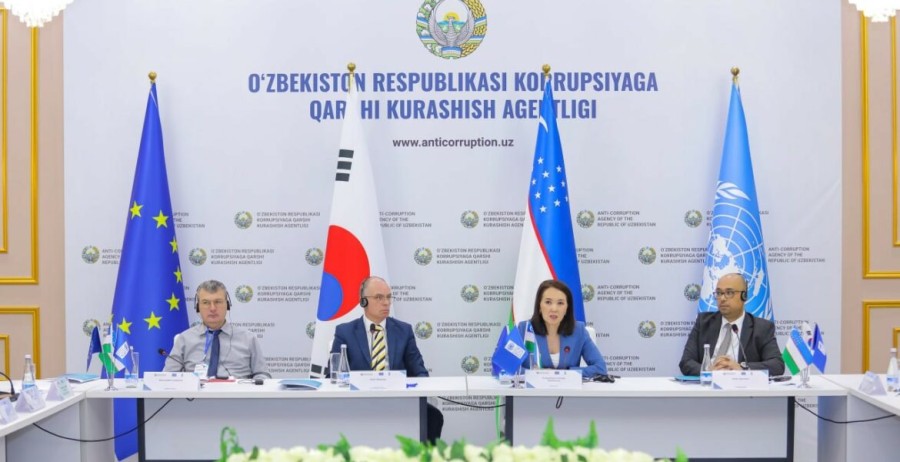
In cooperation with the European Union and the United Nations Development Programme, Uzbekistan launched the Eantikor.uz digital platform and a dedicated call center allowing citizens to report suspected corruption.
The government also allocates approximately 10 billion Uzbek soums annually in grants and social contracts to support civil society initiatives focused on transparency and accountability.
In 2025, authorities launched the Virtual Anti-Corruption Academy, designed to promote integrity education and strengthen professional capacity in public administration.
Recognizing that sustainable reforms require broader participation, Uzbekistan has increased cooperation with civil society organizations, independent experts, and investigative journalists.
International partners — including the United Nations Office on Drugs and Crime and GIZ — have supported training programs, research initiatives, and technical assistance projects aimed at strengthening professional standards in investigative reporting and governance oversight.
A Regional Research Center on Anti-Corruption Issues has also been established as an independent non-governmental institution. The center conducts analytical studies, risk assessments, and monitoring of the implementation of international standards such as the United Nations Convention against Corruption.
Uzbekistan has expanded its global partnerships on anti-corruption governance, hosting the annual Tashkent Anti‑Corruption Forum, which brings together policymakers, international organizations, financial institutions, and civil society representatives.
The country has also launched the Central Asia Regional Anti-Corruption Platform, aimed at strengthening regional cooperation in implementing international transparency standards.
Digital tools such as e-anticor.uz, developed with UNDP support, allow data-driven monitoring of corruption risks and institutional performance.
Uzbekistan now maintains partnerships with more than 15 international organizations and anti-corruption authorities in over 30 countries, formalized through more than 25 bilateral agreements and memoranda.
In recognition of the country’s reform efforts, Uzbekistan has been selected to host the 12th session of the Conference of the States Parties to the United Nations Convention against Corruption in 2027, a major international event on global anti-corruption governance.
Observers say Uzbekistan’s reforms reflect a broader effort to move beyond short-term campaigns toward institutionalized integrity mechanisms.
By combining legal reform, digital transparency, compliance-based prevention, and international cooperation, the country is gradually reshaping its governance framework.
While challenges remain, analysts note that Uzbekistan’s evolving approach offers an example of systemic governance reform in a rapidly transforming Central Asian region, with potential implications for investment, international partnerships, and public trust in state institutions.