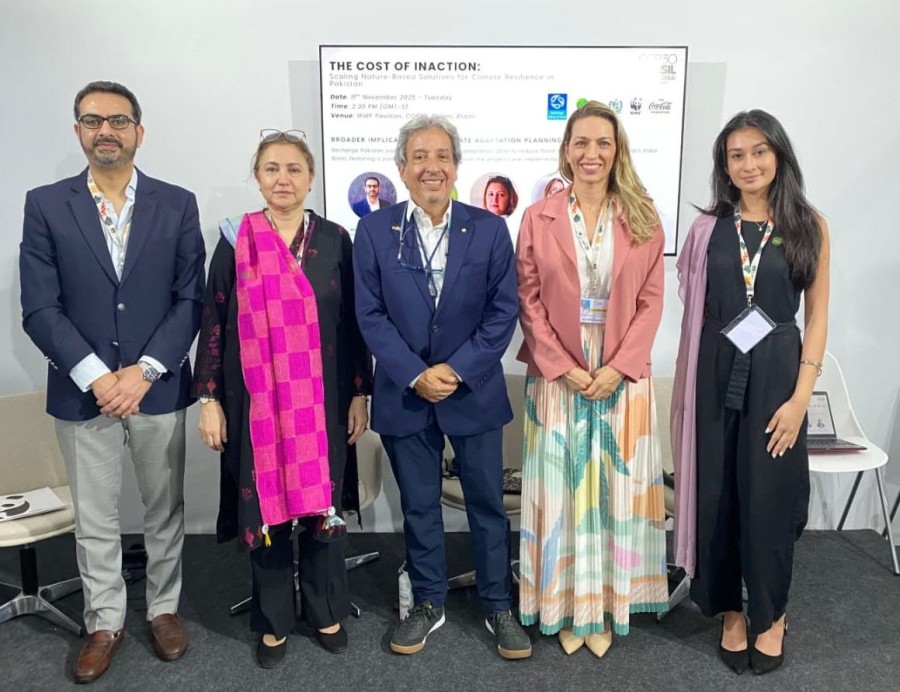
BELÉM, Brazil, Friday, November 14, 2025 (WNP): WWF-Pakistan placed its flagship climate adaptation initiative, Recharge Pakistan, at the center of global attention at COP30, urging the international community to accelerate investment in Nature-based Solutions (NbS) as a cost-effective, scalable, and people-centered response to climate change.
High-level engagements at the Pakistan Pavilion — involving senior officials from the Ministry of Climate Change and Environmental Coordination (MoCC), experts from WWF, and representatives of the Green Climate Fund (GCF) — highlighted Pakistan’s growing leadership in nature-based adaptation and the increasing synergy between government, global climate finance institutions, civil society, and the private sector.
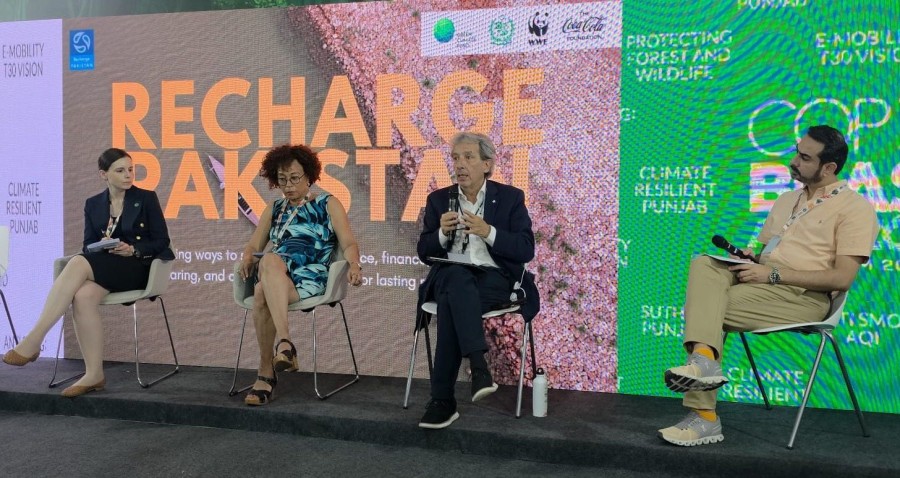
Recharge Pakistan, funded by the GCF, The Coca-Cola Foundation (TCCF), and WWF, is emerging as a model for countries seeking evidence-based and community-driven climate resilience. The programme aims to restore degraded ecosystems, rehabilitate natural water channels, and strengthen climate-smart livelihood practices across vulnerable districts in Balochistan, Khyber Pakhtunkhwa, and Sindh.
Aisha Moriani, Secretary MoCC, emphasized the political resolve behind NbS integration across the country. “While national initiatives set the direction, true transformation happens when NbS take root across provinces,” she said. “The strong provincial engagement, especially the participation of the Chief Minister of Punjab at COP30, reaffirms Pakistan’s collective commitment to climate resilience.”
Manuel Pulgar-Vidal, Global Lead for Climate and Energy at WWF International, underscored the economic rationale behind NbS. “Recharge Pakistan is not just an environmental initiative; it’s an economic one,” he said. “By grounding decisions in data and evidence, it demonstrates how NbS can protect people, nature, and national economies simultaneously.”
Muhammad Fawad Hayat, Senior Director of Recharge Pakistan, stressed that real climate resilience requires systemic alignment. “Large-scale NbS is not just about finance; it is about governance, capacity, and long-term partnerships,” he noted. “When institutions and climate funds align with community priorities, adaptation becomes truly scalable and people-centered.”
From the climate finance perspective, Alexandra Stephenson, Officer for Multilateral Governance at the GCF, described Recharge Pakistan as “one of GCF’s signature projects — a model of how innovative financing and strong governance can converge in a bottom-up, country-led way.” She added that GCF’s shift toward regionalized governance will further enhance country support from conception through implementation.
Marcene Mitchell, Senior Vice President for Climate Change at WWF-US, highlighted the importance of clear national vision to mobilize private-sector financing. “Recharge Pakistan shows what becomes possible when a country signals readiness,” she said. “That clarity attracts investors and encourages broader collaboration.”
Earlier during COP30, WWF-Pakistan also shared early findings from its forthcoming Cost of Inaction report, revealing how NbS interventions could significantly reduce future flood losses across the Indus Basin. The message echoed throughout the conference: investing in NbS now is far more economical than bearing the escalating costs of climate inaction.
Founded in 1970, WWF-Pakistan works to protect the country’s natural resources, biodiversity, and environment. Operating through 26 offices with nearly 250 staff members, the organization leads conservation and climate resilience initiatives across all major regions of Pakistan.