By Rehan Khan
Director Diplomatic & International Affairs
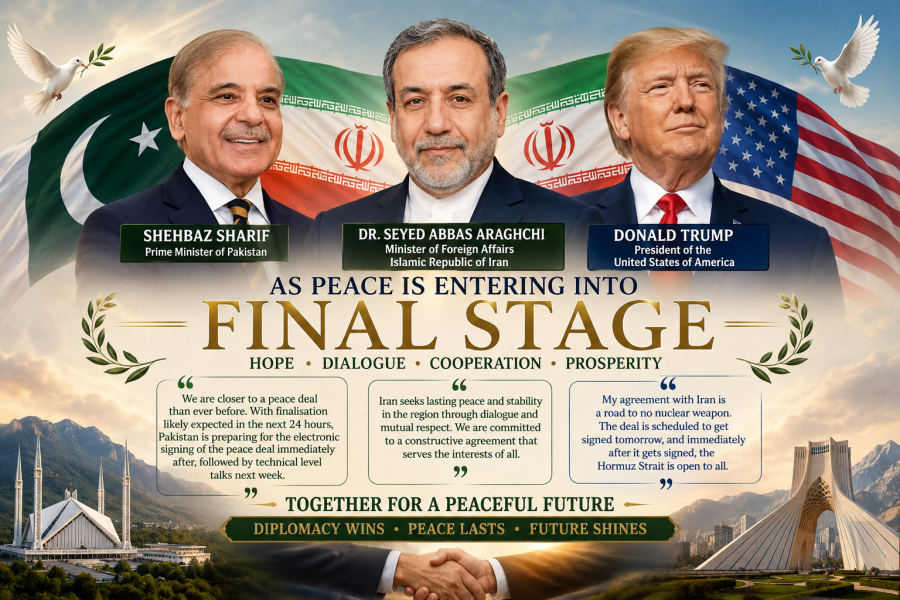
ISLAMABAD, Saturday, June 13, 2026 (WNP): Pakistan on Saturday indicated that a landmark peace agreement involving Iran is closer than ever to completion, with Prime Minister Muhammad Shehbaz Sharif announcing that the finalization of the accord could take place within the next 24 hours.
In a statement on his social media account – X, the prime minister said Pakistan’s intensive mediation efforts had brought the parties to the brink of a historic breakthrough and that preparations were underway for the formal conclusion of the agreement.
“We are closer to a peace deal than ever before. With finalisation likely expected in the next 24 hours, Pakistan is preparing for the electronic signing of the peace deal immediately after, followed by technical-level talks next week,” Prime Minister Shehbaz Sharif said.
The prime minister thanked both the United States and Iran for their continued engagement in the negotiations and acknowledged the support provided by regional partners.
“We would like to thank the United States of America and the Islamic Republic of Iran for their ongoing commitment during the negotiations, and we extend our sincere appreciation to our brothers in the region for their support. We are confident that this historic peace deal will form a strong foundation for lasting peace,” he added.
The announcement came as reports emerged that Iranian Foreign Minister Dr. Seyed Abbas Araghchi will arrive in Islamabad on Sunday at the head of a high-level delegation, further fueling expectations that the final phase of the negotiations is underway.
Diplomatic sources described Araghchi’s visit as highly significant, with observers viewing Islamabad as the focal point of the ongoing diplomatic efforts that have brought the prospective agreement to its final stages.
Adding to the momentum, U.S. President Donald Trump said on his Truth Social platform that the agreement with Iran was scheduled to be signed on Sunday and would mark a major turning point in relations between the two countries.
“The deal is scheduled to get signed tomorrow, and immediately after it gets signed, the Hormuz Strait is open to all,” Trump wrote.
The U.S. president described the prospective agreement as fundamentally different from the 2015 Joint Comprehensive Plan of Action (JCPOA), arguing that the new arrangement would permanently prevent Iran from obtaining a nuclear weapon.
“My agreement with Iran is the exact opposite, a road to no nuclear weapon,” Trump stated. “In fact, they no longer want a nuclear weapon, nor will they have one, either through purchase, development, or any other form of procurement.”
Trump also expressed optimism about future cooperation with Tehran and broader regional stability, saying the United States looked forward to working with Iran and countries across the Middle East in the years ahead.
However, Iranian officials appeared to temper expectations regarding the timing of the signing ceremony.
While confirming that negotiations had reached an advanced stage, Iranian sources reportedly stated that although an agreement could be finalized within the coming days, it was not expected to be formally signed on Sunday.
Earlier, Iranian Foreign Minister Araghchi had urged the media to avoid speculation regarding the contents of the proposed Islamabad Memorandum of Understanding until its finalization, stating that all details would be made public at the appropriate time.
The latest developments come amid an intense diplomatic push led by Pakistan, which has played a central mediating role in facilitating dialogue between the parties and helping bridge remaining differences.
Regional and international observers are closely monitoring the process, with expectations growing that a successful agreement could ease tensions, strengthen regional stability, enhance maritime security in the Strait of Hormuz, and contribute to global energy market confidence.
Should the accord be finalized, it would represent one of the most significant diplomatic breakthroughs in the region in recent years and further underscore Pakistan’s emerging role as a facilitator of dialogue and conflict resolution in international affairs.