DAVOS, Tuesday, January 20, 2026 (WNP): Canadian Prime Minister Mark Carney on Tuesday delivered a wide-ranging and candid address at the World Economic Forum’s Annual Meeting 2026, warning that the world is facing a fundamental rupture in the global order and urging middle powers to act collectively, honestly and decisively in an era of intensifying great-power rivalry.
Speaking to political and business leaders in Davos, Carney said the long-held notion of a stable, rules-based international order has given way to a “harsh reality” in which major powers increasingly operate without constraints, using economic integration, tariffs, finance and supply chains as instruments of coercion.
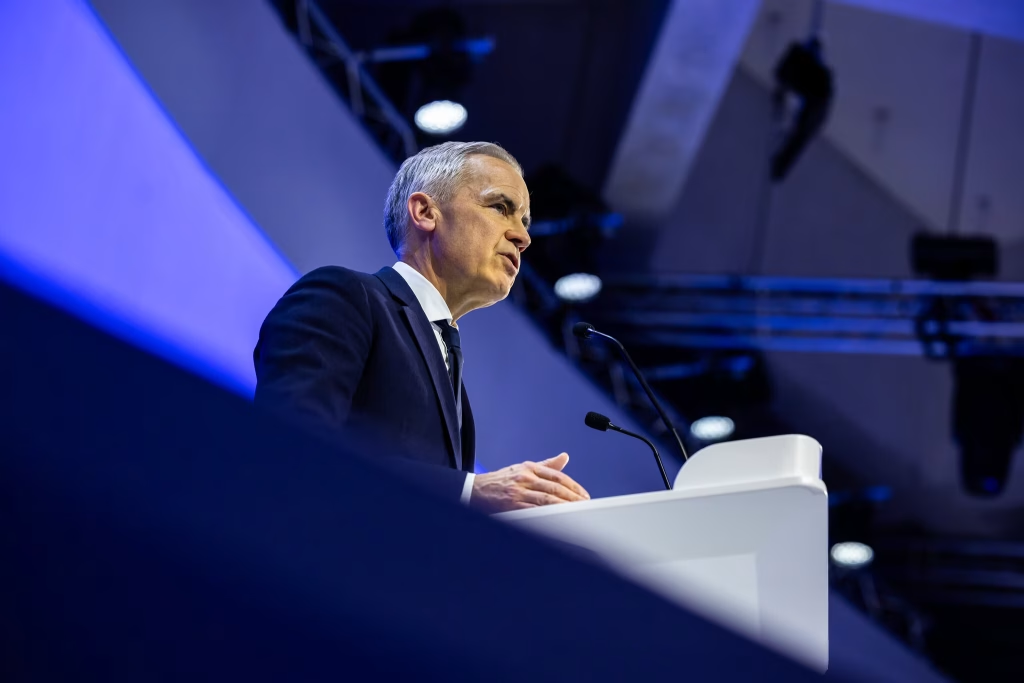
“We are not in a transition; we are in the midst of a rupture,” he said, adding that the assumption that global rules protect all states equally “no longer works.”
Despite this, the Canadian prime minister rejected the idea that middle powers are powerless. Countries such as Canada, he argued, still have the capacity to shape a new international order grounded in shared values, including respect for human rights, sustainable development, sovereignty and territorial integrity.
Drawing on Czech dissident and former president Václav Havel’s essay The Power of the Powerless, Carney warned against what he described as “living within a lie” — the ritualistic endorsement of an international system that no longer functions as advertised.
“When even one person stops performing, the illusion begins to crack,” he said. “It is time for companies and countries to take their signs down.”
Carney acknowledged that Canada and other like-minded nations had benefited for decades from the predictability of the post-war order, even while being aware of its inconsistencies and selective application of international law. That bargain, he said, has now collapsed as global crises and geopolitical tensions expose the vulnerabilities of extreme economic interdependence.
He cautioned, however, against a retreat into isolationism, warning that a “world of fortresses” would be poorer, more fragile and less sustainable. Instead, he called for shared investments in resilience, arguing that collective solutions are cheaper and more effective than unilateral strategies.
Outlining Canada’s response, Carney said his government has adopted what he termed “value-based realism” — a foreign policy that is principled in defending core values while pragmatic in engaging with a complex and divided world.
“We actively take on the world as it is, not wait for a world we wish to be,” he said.
Domestically, Carney highlighted measures to strengthen Canada’s economic and strategic foundations, including tax cuts, the removal of federal barriers to interprovincial trade, fast-tracking nearly one trillion dollars in investments in energy, artificial intelligence, critical minerals and trade corridors, and plans to double defence spending by the end of the decade.
Internationally, he pointed to Canada’s rapid diversification of partnerships, including a comprehensive strategic partnership with the European Union, new trade and security agreements across four continents, and recently concluded strategic understandings with China and Qatar. He said negotiations are also underway on free trade agreements with India, ASEAN, Thailand, the Philippines and Mercosur.
Carney underscored Canada’s commitment to “variable geometry” — forming different coalitions for different challenges. He cited Canada’s role in supporting Ukraine, its firm backing of Greenland and Denmark on Arctic sovereignty, and its opposition to tariffs linked to Greenland, calling instead for dialogue to advance shared security and prosperity in the Arctic.
He reaffirmed Canada’s unwavering commitment to NATO’s Article 5 and detailed major investments to strengthen the alliance’s northern and western flanks, including advanced radar systems, submarines, aircraft and increased troop deployments.
On global economic governance, Carney said Canada is championing efforts to bridge major trade blocs, diversify critical mineral supply chains through G7-anchored buyers’ clubs, and cooperate with democratic partners on artificial intelligence to avoid dependence on dominant powers or technology giants.
“The choice for middle powers is clear,” he said. “Either compete with each other for favour, or combine to create a third path with real impact.”
Calling for greater honesty in international relations, Carney urged countries to stop invoking the rules-based order as if it still functions fully, apply consistent standards to allies and rivals alike, and reduce vulnerabilities that enable economic coercion.
He concluded by describing Canada as a stable, pluralistic and reliable partner with vast energy resources, critical minerals, world-class human capital and strong fiscal capacity, capable of helping build a more just and resilient global system.
“We are taking the sign out of the window,” Carney said. “Nostalgia is not a strategy. From this fracture, we can build something stronger and fairer — if middle powers choose to act together.”
“This is Canada’s path,” he added. “And it is open to any country willing to take it with us.”