

By Shayan Sumbal
An M.Phil Scholar of International
Relations at the National Defense
University (NDU), specializing in
global security and foreign policy
ISLAMABAD, Tuesday, June 23, 2026 (WNP): Nuclear weapons pose a fundamental dilemma in international security. In one regard, they are helpful in averting war; whereas, they are also used as catalysts for igniting war. South Asia best exemplifies this equation, where Pakistan’s nuclear doctrine is operating in an uncertain security condition largely characterized by its contestation with India, conventional asymmetry, and its recent sabre rattling in 2025. Whether the events that unfolded in the recent past have changed the hawkish mindset regarding nuclear weapons and conventional warfare remain the question of utmost importance. This paper will analyze Nuclear Doctrine of Pakistan through the prism of Nuclear Deterrence and Stability-Instability paradox. The question that arises is;
Does Pakistan’s Nuclear Doctrine, Full Spectrum Deterrence and Strategic Ambiguity, stabilize or destabilize the South Asian region?
Pakistan does not abide by No First Use policy (NFU). It has not officially declared its nuclear policy vis à vis India clearly regarding its nuclear weapons use, thus subscribing to Strategic Ambiguity. Owing to this uncertainty from Pakistan’s end, India developed its military strategy of Cold Start Doctrine (CSD). Based on CSD, India could seize Pakistan’s territory in case any crisis hit.
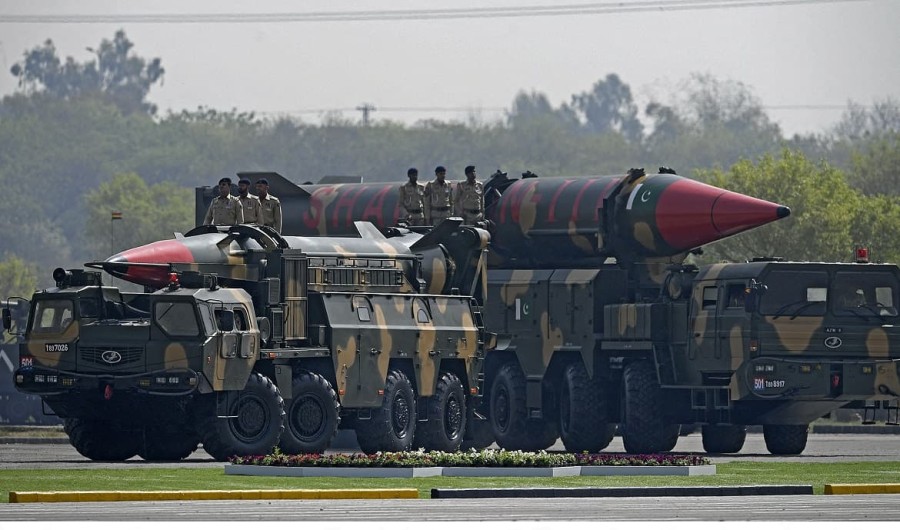
Maintaining Credible Minimum Deterrence for defensive purposes has been a nuclear posture of Pakistan until 2013. In response to India’s CSD, Pakistan changed its nuclear posture to Full Spectrum Deterrence (FSD). Under the ambit of FSD, Pakistan developed tactical nuclear weapons in case of any future conflict with India. This doctrine lays out four scenarios in which the use of nuclear weapons could be resorted to, namely; spatial threshold, military threshold, economic threshold, and political threshold.
John Mearsheimer, a leading proponent of Nuclear Deterrence theory, is of the opinion that “the more horrible the prospect of war, the less likely it is to occur.” During the Cold War, both Soviet Union and United States possessed nuclear weapons. Both could not risk nuclear escalation and war. Nuclear weapons helped maintain peace in Europe. Similarly, in South Asian context, India and Pakistan’s possession of nuclear weapons serve as a peacemaker and peacekeeper. The ambiguous nature of doctrine has also been helpful in preventing major war(s) between the two actors.
Nuclear weapons as a source of instability can be best explained through Stability-Instability paradox. In case of South Asia, both India and Pakistan, even though refraining from full blown war, engage in border skirmishes, supporting proxies and insurgencies, and limited war. History is testimony to the fact that such small-scale conflicts could shape and alter the course of events.
Miscalculation on any part could sabotage peace. For instance: the crises of 1987 and 1990, where the United States had to intervene to de-escalate the conflict.
Moreover, Pakistan’s development of Tactical nuclear weapons poses a dilemma and sits well with Stability-Instability paradox. On one hand, they are expected to deter the enemy from launching an attack and act as stabilizing factor in the region. On the other hand, the actual use and deployment of these weapons bear several challenges like command & control problem, risk of nukes, disruption of communication, and escalation into full blown nuclear war. The risk of escalation is at the core of stability-instability paradox.
Furthermore, the recent Indo-Pak strife of 2025 exposed the core conundrum of Pakistan’s nuclear doctrine, i-e: the failure of primary objective of Pakistan’s nuclear doctrine, its inability to deter conventional military action from India which could eventually pave the way for nuclear warfare.
Nuclear weapons have been instrumental in averting large scale conflicts between India and Pakistan, but they have failed to deliver lasting peace in its true letter and spirit. Instead, they have resulted in creating a system which is very easily prone to crisis. Pakistan’s shift to Full Spectrum Deterrence (FSD) and India’s 2025 aggressive behavior reflect that India will not stop carrying out attacks no matter how big or small the warning or retaliation threat from Pakistan is.
According to SIPRI 2025 yearbook, Pakistan possesses 170 nuclear weapons. It is building up on its nuclear arsenal. In 2025, India’s use of conventional military weapons is putting the deterrent strategy of Pakistan in question. This could, in turn, prompt escalation. The dynamics of Indo-Pak nuclear rivalry is far reaching. In 2024, the United States of America imposed sanctions on Pakistan’s state-owned organization owing to its modern and developed missile program. It is also suspected by the US intelligence agencies that Pakistan could develop Intercontinental Ballistic Missiles (ICBMs). Therefore, it is worrisome for many actors if both India and Pakistan engage in the pursuit of nuclear modernization. This in turn will have a trickle-down effect, ranging from regional to global level.