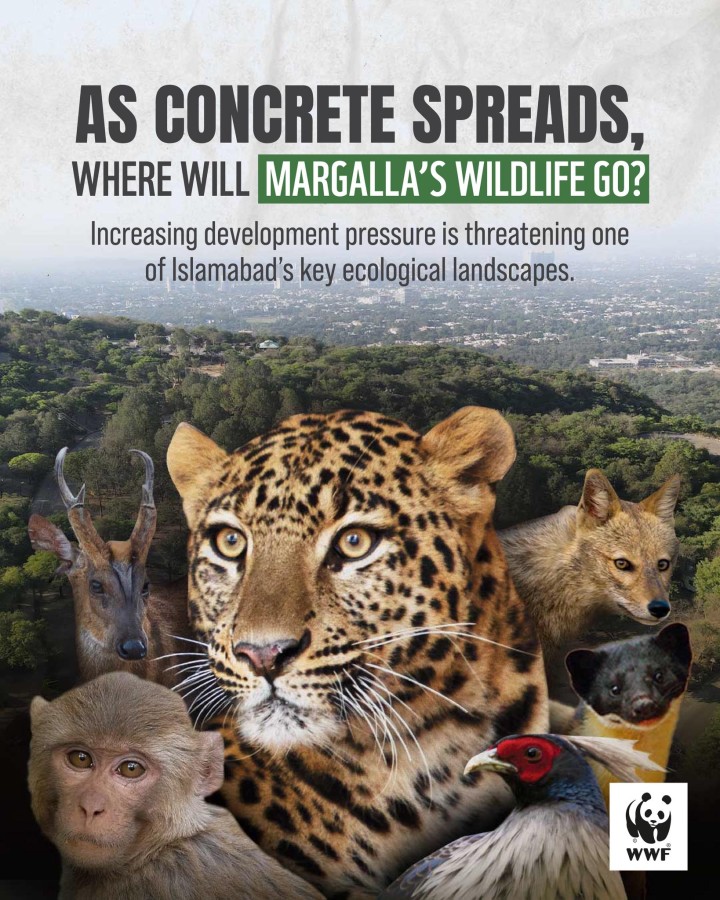
ISLAMABAD, Friday, April 24, 2026 (WNP): WWF-Pakistan has expressed serious and escalating concern over ongoing and proposed development activities in areas adjoining the Margalla Hills National Park, particularly within ecologically sensitive foothill zones.
In a statement, WWF-Pakistan said recent assessments conducted earlier this year indicated large-scale vegetation clearance and infrastructure expansion across multiple locations within the Islamabad Capital Territory. These developments, it noted, have also drawn widespread concern from environmental experts, civil society organizations, and the general public.
The organization highlighted that Margalla Hills National Park and its surrounding habitats constitute a critical ecological landscape, supporting diverse flora and fauna, including key bird and mammal species. It further emphasized that the park serves as the “lungs” of the capital and plays a vital role in natural water filtration.
WWF-Pakistan warned that development activities in close proximity to the park—regardless of their location within or outside designated buffer zones—pose serious and potentially irreversible risks.
These include habitat fragmentation, disruption of wildlife movement corridors, and degradation of essential ecosystem services such as groundwater recharge and micro-climate regulation.
Citing field-based evidence, the organization said the cumulative expansion of road networks, land clearing, and related infrastructure—particularly along corridors such as the Margalla Enclave Link Road and adjoining foothill areas—has already led to measurable ecological degradation. While acknowledging that some activities may involve the removal of invasive species, WWF-Pakistan said the scale and pattern of clearing suggest broader development-driven impacts.
The statement further noted that recent official announcements regarding proposed development in the Margalla foothills have intensified concerns, as the plans reportedly include large-scale infrastructure such as hotels, sports facilities, and associated projects.
WWF-Pakistan also expressed reservations over the limited public availability of Environmental Impact Assessments (EIAs), inadequate stakeholder consultation, and the absence of clearly defined ecological restoration and mitigation strategies for several initiatives.
In view of the ecological sensitivity of the area, the organization urged the Capital Development Authority, in coordination with the Islamabad Wildlife Management Board, to take immediate measures.
These include formally designating and enforcing “no-go” zones within and around the national park, particularly in critical habitats and wildlife corridors, where all forms of development should be prohibited. It also called for ensuring that any development outside such zones undergoes comprehensive, independently reviewed EIAs with full public disclosure and stakeholder consultation prior to approval.
Furthermore, WWF-Pakistan urged authorities to immediately suspend all ongoing and proposed development activities in sensitive foothill areas pending a transparent environmental review.
The organization reiterated its commitment to constructive engagement and offered support for developing a science-based and environmentally responsible pathway forward to protect the Margalla Hills ecosystem.