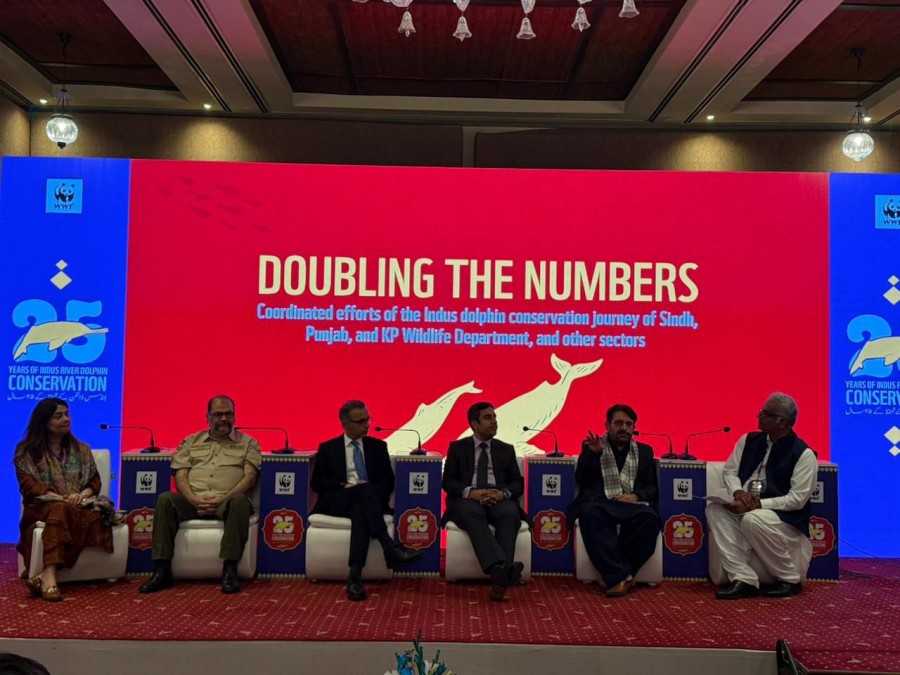
ISLAMABAD, Thursday, December 4, 2025 (WNP): WWF-Pakistan on Thursday marked 25 years of sustained conservation efforts for the Indus River Dolphin, Pakistan’s endemic and iconic freshwater species, at a special event in Islamabad, highlighting both a major ecological success and the need to address persistent threats to ensure the species’ long-term survival.
Once on the brink of extinction, the Indus River Dolphin population has nearly doubled to an estimated 2,000 individuals, a milestone widely regarded as one of Pakistan’s most significant wildlife conservation achievements.
Addressing the event, Federal Minister for Climate Change Senator Musadik Malik underscored the importance of continued, coordinated action to safeguard the gains made over the past quarter-century.
“The Indus River Dolphin is not only a symbol of Pakistan’s natural heritage but also a powerful testament to what sustained and collaborative conservation efforts can achieve,” he said. Praising WWF-Pakistan and its partners, the minister noted that Pakistan is a signatory to the Global Declaration of River Dolphins (2023)—the world’s first political commitment dedicated exclusively to river dolphin conservation—and reaffirmed the government’s resolve to work with all stakeholders to secure a thriving future for the species.
Over the past 25 years, WWF-Pakistan’s approach has evolved from early population surveys that established a scientific baseline for understanding the dolphin’s decline and distribution, to extensive community engagement programmes that helped eliminate harmful practices and promote local stewardship. In collaboration with government partners, WWF also established specialized rescue units to safely return dolphins trapped in irrigation canals back to the river system.
Advances in satellite tracking and monitoring technologies have further improved understanding of dolphin movement, habitat use, river fragmentation, and other ecological pressures, enabling more targeted conservation interventions.
These initiatives—implemented in close partnership with the Ministry of Climate Change, provincial wildlife and fisheries departments in Punjab, Sindh, and Khyber Pakhtunkhwa, irrigation departments, environmental protection agencies, and academic institutions—have been supported by international donors including UK International Development and the Darwin Initiative, as well as private-sector partners such as the Engro Foundation and Bank Alfalah.
Speaking on the occasion, Hammad Naqi Khan, Director General WWF-Pakistan, said the dolphin’s recovery reflects the strength of collaboration between conservation organizations, government institutions, and riverine communities.
“Our partners and local communities have played a critical role in improving habitat protection and strengthening rescue and monitoring operations,” he said, adding that sustained cooperation remains essential to protect the species against emerging threats.
To mark the milestone, WWF-Pakistan recently convened a two-day consultative workshop on December 3–4, bringing together government officials, researchers, and conservation partners to develop a new Indus River Dolphin Conservation Action Plan. The workshop reviewed progress since the 2011 National Action Plan, assessed current population trends, evaluated ongoing threats, and identified priority actions for the next five years—reaffirming Pakistan’s long-term commitment to river dolphin conservation.